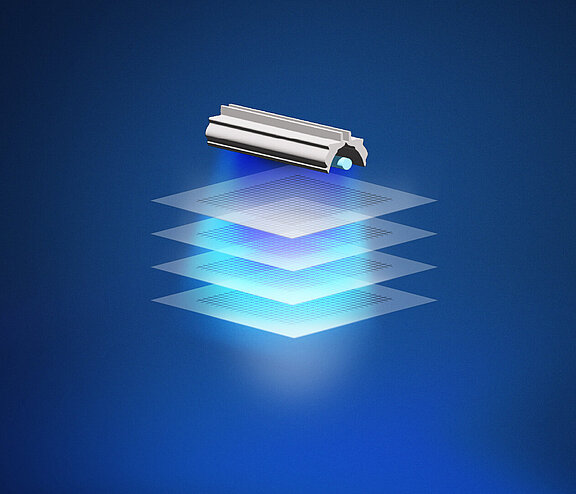
In inerting, inks and coatings are cured under oxygen-reduced conditions. Reducing the oxygen content minimizes oxygen inhibition and supports surface curing. In combination with suitable chemistry, the process can also enable the use of reduced-photoinitiator formulations.
The targeted reduction of oxygen creates defined conditions for the UV curing process. Particularly with reactive coatings, UV printing inks and adhesives, this can improve surface curing.
A key application area for inerting is the production of packaging using UV inks and coatings with formulations specifically designed for use under inert conditions. By reducing the photoinitiator content, the technology can also be used in the production of low-migration food packaging. Suitability depends on the formulation used and the applicable regulatory requirements.
Our inerting solutions are used, among other applications, for:
PVC flooring
Automotive components
Food packaging
Decorative papers
Thermal papers, plastic films and aluminium composite materials
Siliconized webs
During inerting, the oxygen content in the UV irradiation zone is specifically reduced, usually by using nitrogen (N₂) as an inert gas. This oxygen-reduced atmosphere minimizes oxygen inhibition, which can interfere with the UV curing process. Depending on the application, the required residual oxygen content ranges from 50 to 500 ppm (equivalent to 0.005 to 0.05%).
Nitrogen is suitable for inerting because it is non-toxic and non-explosive and makes up around 78% of ambient air. It can therefore be used as an inert gas in industrial UV curing processes.
During inerting, the substrate to be cured is guided through an enclosed chamber in which the ambient air is displaced by the controlled supply of nitrogen (N₂). This creates an oxygen-reduced atmosphere that supports UV curing by reducing oxygen inhibition.
The UV lamp housing is positioned above the tightly sealed inerting chamber. Labyrinth seals and a nitrogen doctor-blade nozzle help isolate the chamber from ambient air. Uniform nitrogen filling nozzles ensure defined conditions inside the chamber, while UV irradiation takes place through a quartz glass pane. A water-cooled counter-reflector provides heat dissipation and radiation shielding.

In combination with suitable chemistry, inerting enables crosslinking under oxygen-reduced conditions. This is particularly relevant for applications requiring defined surface properties or low-migration formulations – for example, food packaging or resistant coatings.
In addition to short curing times and the possibility of immediate further processing, UV curing under oxygen-reduced conditions can offer further benefits depending on the application:
High surface resistance: Reduced oxygen inhibition supports the formation of surfaces with high hardness as well as wear and chemical resistance.
Support for surface curing: The reduced oxygen content decreases oxygen inhibition and supports the crosslinking reaction.
Potential to reduce system requirements: Depending on the application, formulation and process configuration, the required UV output or number of UV units can be reduced. This can also reduce electrical energy demand as well as maintenance and spare-parts requirements.
Reduced photoinitiator content: Depending on the formulation, a lower proportion of photoinitiators can be used under inert conditions.
Stable process conditions: A defined residual oxygen content supports reproducible curing results.
Reduced ozone formation in the irradiation zone: Due to the reduced oxygen content, less oxygen is available for ozone formation by short-wave UV radiation.
Demand-based use of materials: Depending on the application, reduced-photoinitiator formulations can reduce the use of corresponding formulation components.
The achievable results and potential savings depend on factors including the formulation, substrate, coating thickness, production speed, required degree of cure and system configuration.
To ensure consistent process conditions and product quality, the residual oxygen content in the inerting chamber is continuously monitored. The system controls the nitrogen supply to maintain the specified oxygen concentration. If the set target value is not reached, an error message is generated – optionally combined with a stop signal for the coating or printing machine. This supports the monitoring of defined process conditions.