UV curing (UV drying) uses ultraviolet light to rapidly cure suitable printing inks and coatings on large-area substrates such as flexible packaging, labels and textiles. Short curing times enable high production speeds and immediate further processing. Even at high printing speeds, UV curing supports consistently high print quality.
The rapid curing of printing inks or coatings with UV light enables immediate further processing. UV systems therefore support short process times as well as high color and print quality.
LED UV curing in particular has become established as a high-performance alternative to conventional mercury vapor lamps. LED UV systems allow LED segments to be switched on and off as required and have a lower proportion of infrared radiation, which can reduce the thermal load on the substrate. The long service life of LEDs can also reduce maintenance requirements. LED UV systems contain no mercury. At the LED wavelengths used, no process-related ozone is generated. Due to these characteristics, LED UV systems are increasingly being used for a wide range of web printing applications.
With UV and LED UV systems specifically designed for web applications, we support efficient production processes and high print quality – with technologies engineered to meet the requirements of high-performance industrial printing processes.
The UV curing process plays a key role in various industries, including printing, coating and surface treatment. Photoinitiators and their by-products can be particularly relevant in migration-sensitive applications. Reducing or eliminating photoinitiators can therefore be beneficial for such applications.
This is where our FREEcure system comes in. With its particularly high proportion of short-wave UV radiation, FREEcure enables curing without photoinitiators or with a reduced photoinitiator content when suitable formulations are used. FREEcure systems are already used in industrial applications, for example in the printing sector, where photoinitiator-free or reduced-photoinitiator offset and flexographic printing inks are cured at speeds of up to 200 metres per minute.
In formulations designed for this purpose, the short-wave spectral range supports direct photochemical initiation and crosslinking. This allows suitable coating and ink systems to be formulated without photoinitiators or with a reduced photoinitiator content compared with conventional formulations. This can help reduce corresponding potential sources of migration. However, actual migration and suitability for a specific application depend on the entire system and the respective process conditions.
In suitable applications, FREEcure also offers the potential to reduce the number of UV units required. This can provide benefits in terms of space requirements as well as energy, maintenance and operating costs. The actual savings achievable depend on the formulation, production speed, layer thickness, substrate, required degree of cure and the respective reference system.
Discover the possibilities of UV direct cross-linking - for photoinitiator-free and reduced-photoinitiator UV curing processes.


Commercial printing refers to the process of printing promotional materials such as brochures, flyers and catalogues for business purposes. UV curing is ideal for commercial printing as it enables fast curing of the ink, resulting in improved print quality and reduced production times. UV curing technology is particularly well suited to multi-colour wet-on-wet printing as it enables precise and fast curing without smudging or smearing. UV curing also offers flexibility in the choice of curing source – from conventional UV lamps and LED UV to hybrid solutions. Depending on the application, the technologies offer different characteristics in terms of UV spectrum, output control, energy demand and process integration.

Newspaper printing is a specialised printing process used for the mass production of newspapers, with a focus on fast printing speeds and cost-efficient production. In combination with UV printing, coated papers can be used in coldset presses, allowing newspaper printers to produce commercial products.
Article “New opportunities for coldset” in Deutscher Drucker

Heatset printing is a process in which the ink is dried using heat to enable faster drying times and better adhesion to smooth surfaces such as glossy paper. In the heatset printing industry, UV curing can be used as an alternative to conventional gas drying. Rapid curing enables short process times and immediate further processing.
UV curing suitable for high speed, both with classic UV lamp and with LED UV as an alternative to the heatset dryer
Number of lamp/LED units depending on the production speed
Top and bottom of the web are cured almost simultaneously
Wet-on-wet printing without intermediate drying - curing after the last print job
Production speeds depending on the printing machine up to approx. 1000 m/min

Liquid packaging refers to packaging specifically designed for the storage and transport of liquids such as beverages, sauces or detergents. UV curing is an ideal technology for liquid packaging as it enables immediate curing of the ink and thus reduces production time, which is crucial for fast roll-to-roll processing of large quantities of packaging.
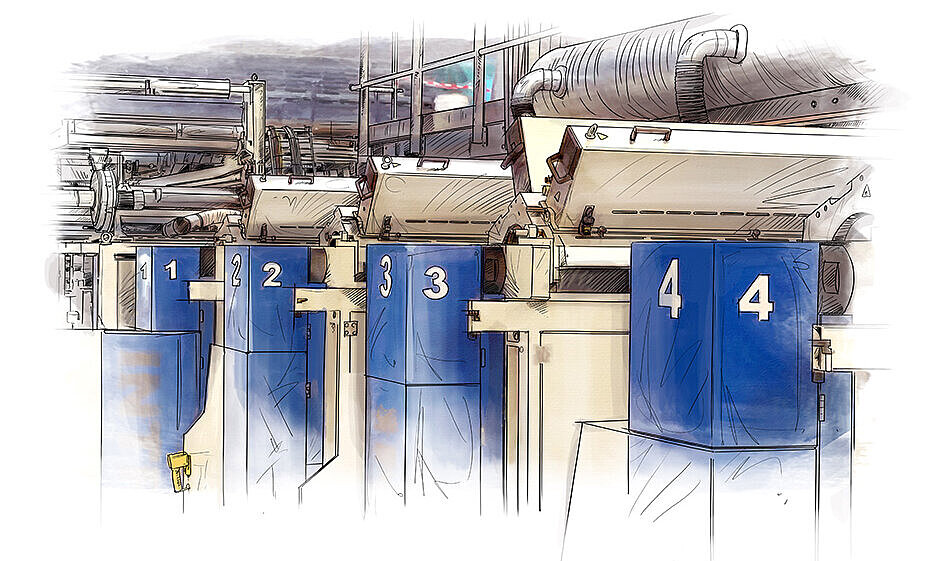
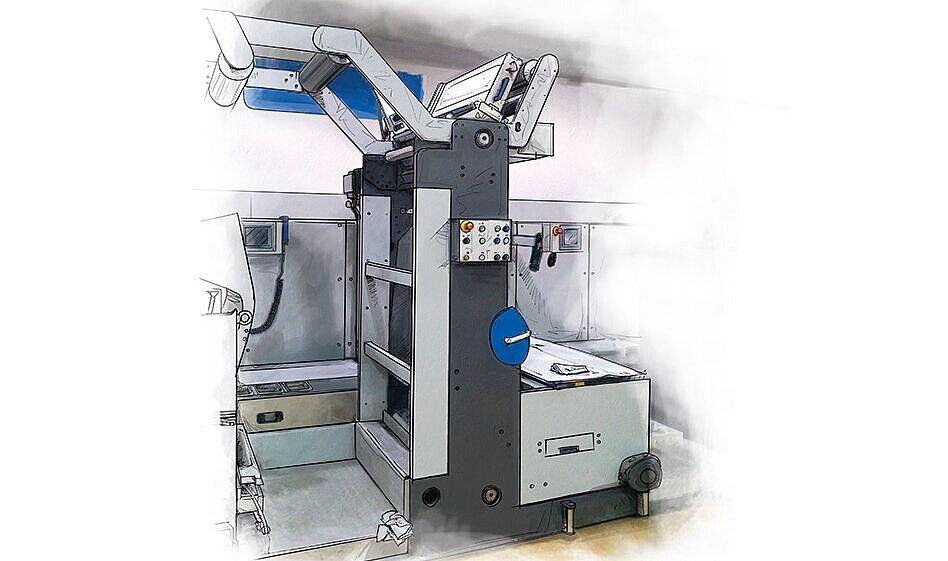

Flexible packaging is packaging material made of easily deformable materials such as plastic films, aluminium foils or paper and is often used for food, beverages and other consumer goods. UV curing is ideal for flexible packaging as it enables instant drying of the ink on various materials such as plastic films, resulting in increased productivity and improved quality.

Gravure printing is a printing process in which the ink is transferred from the recessed areas of a printing plate to the paper, resulting in high print quality and colour intensity. UV printing or UV varnishing is an ideal addition for creating tactile and visual effects.
UV curing system with classic UV lamp specially developed for varnish finishing in gravure printing
Installation of the lamp units on a counter panel (folding carton) or over a chill roll (flexible packaging)

Decorative printing refers to the process of printing decorative surfaces on film or paper to achieve aesthetic effects. Due to the achievable colour gamut and the chemical and physical resistance of UV formulations, UV printing is an ideal process for this.

"Specials" is a term used in the printing industry to refer to special or customised print jobs that fall outside of standard products and processes.

Security printing is based on the key factors of a complex process, special material mix of paper, colours and foils as well as design. This requires a wide range of different UV printing and finishing technologies. The security features and a large part of the expertise required to print the banknotes are subject to confidentiality.
My many years of expertise as a design engineer and deep understanding of complex UV applications leads to my passion for maximising the efficiency of each application through the right combination of suitable technologies and engineering.