
Increasing demands on modern coating processes
The wood and furniture industry are under increasing pressure to make production processes more energy-efficient, sustainable, and compliant with regulations. The curing of UV coatings is coming under particular scrutiny, as conventional processes consume a lot of energy and usually rely on photoinitiators that are relevant for migration. At the same time, legal requirements are tightening the permissible content of volatile organic compounds (VOCs) and substances with potentially harmful effects on health, which affects both production processes and end products.
While UV-based curing systems have long been considered particularly efficient, they are now increasingly reaching their technical, ecological, and economic limits. The development of alternative processes that do not use energy-intensive UV curing systems or drastically reduce their number is therefore a decisive step toward sustainable industrial coating technologies.


Challenges of conventional UV and thermal curing processes
High energy consumption and rising operating costs
UV curing systems with conventional medium-pressure lamps require enormous amounts of energy to ensure the polymerization process. Depending on the application, several UV-units are often used in series — especially in high-speed factories in the furniture industry. Operating these units causes high electrical loads, additional waste heat, increased air conditioning costs, and higher CO₂ emissions.
Problem photoinitiators: regulations, migration, odor
Photoinitiators are required to activate classic UV polymerization. These are the focus of regulatory and health discussions: they can migrate, lead to significant odor development, and must meet increasingly restrictive legal requirements. In addition, there are repeated supply fluctuations and rising prices.
Oxygen inhibition and technical complexity
Oxygen inhibition reduces the reactivity of the upper layer areas and can lead to insufficient curing or reduced scratch and chemical resistance. Common countermeasures such as nitrogen inerting or additional excimer/electron beam units increase technical complexity and operating costs.
Limitations of conventional technologies
The challenges mentioned above lead to rising energy costs, increasing space requirements, high spare parts costs, and limited occupational safety. The industry therefore needs new, more sustainable solutions.
FREEcure – a new approach to UV curing without photoinitiators
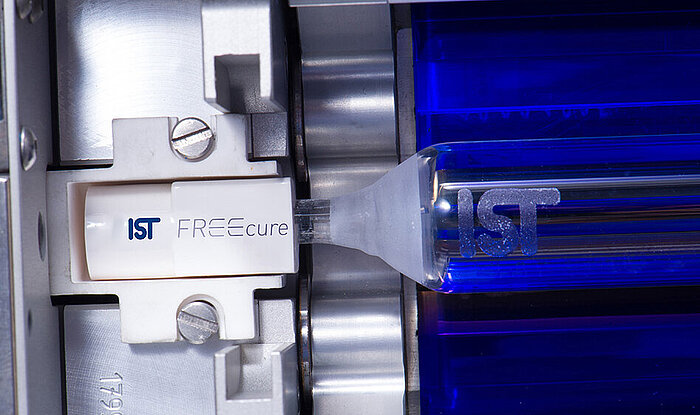
FREEcure enables the direct cleavage of C=C double bonds without photoinitiators for the first time. This is based on an extremely high proportion of high-energy UVC light in the range below 220 nm, which exceeds the binding energy of the double bonds and thus directly triggers the polymerization process.
Technological principle
The process is based on a shift and amplification of the UVC spectrum, which is achieved through optimized lamp and plasma technology, special materials, and customized electronic control. The result is a UVC performance increase of over 70% compared to standard medium-pressure systems.
Material requirements
Binder screenings show that FREEcure is suitable for both 100% UV systems and aqueous UV dispersions. Binders with suitable functionality and physical pre-drying are particularly relevant for water-based systems.
Industrial advantages for the wood and furniture industry
- Massive energy savings through reduction of UV dryers: FREEcure enables speeds of 30–50 m/min per unit. Even for high-speed lines, only 2–3 dryers are required. Energy savings of up to 75% are possible.
- Space savings and reduced plant engineering: Fewer dryers mean less space requirements, simpler line layouts, and reduced spare parts and maintenance costs.
- Low-migration and low-odor coatings: Since photoinitiators can be eliminated or greatly reduced, odor, migration, and regulatory risk are reduced.
- Improved workplace safety: The elimination of ozone risks, inerting, and high radiator loads increases the safety of the production environment.
Comparison: FREEcure vs. established technologies
FREEcure combines the advantages of classic UV curing with minimal energy and regulatory requirements and clearly distinguishes itself from UV LED, thermal curing, and standard UV.
Practical examples in the wood and furniture industry
- High-speed coating lines
- Kitchen surfaces and interior fittings
- Colored UV water-based coatings
- Combination of UV-LED (depth) and FREEcure (surface)
Opportunities for companies
Companies benefit from reduced operating costs, a smaller carbon footprint, regulatory certainty, short payback periods, and sustainable competitive advantages.
Conclusion
FREEcure enables photoinitiator-free or low-photoinitiator curing, energy savings of up to 75%, reduced number of UV dryers, excellent surface properties, and high production speeds. FREEcure thus sets new standards for sustainable and high-performance surface treatment in the wood and furniture industry.